At the heart of tourism are quality services, cooperation between businesses, and the need for substantial support for local investment.
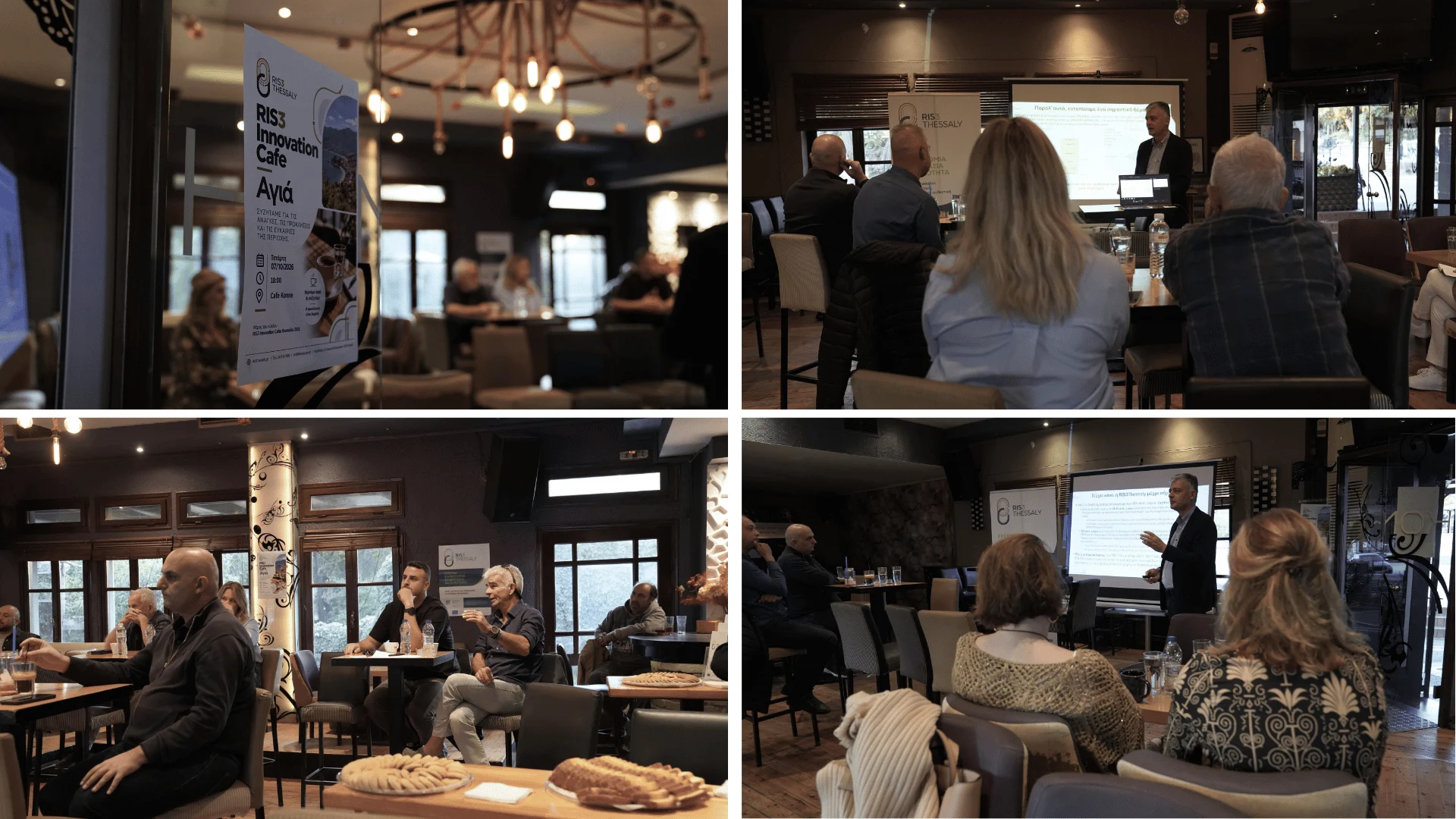
The cycle of Agia continued on Wednesday, October 7, 2026. RIS3 Innovation Cafés, in the context of the actions of the Regional Mechanism RIS3 Thessaly. The meeting took place at Café Konne, in the central square of Agia, with the participation of representatives of the local government, professionals and entrepreneurs from the region.
The goal of the RIS3 Innovation Cafés is to create an immediate channel of communication with the local communities of Thessaly and to document first-hand the needs, difficulties, and suggestions of the entrepreneurial community, so that these can be taken into account in the planning of the Region’s future actions and funding instruments.
In Agia, the discussion focused particularly on two sectors with a significant impact on the local economy: tourism and the agro-food complex.
Tourism: quality, investments and the need for a clearer development framework
In the tourism sector, the participants highlighted the region’s strong seasonality, the need to upgrade accommodation facilities and the services provided, as well as the issue of the relationship between price and quality.
Special emphasis was placed on the need to strengthen the healthy competition, As the creation of new and the upgrading of existing tourist units can serve as an incentive for the overall improvement of the tourism product, it was emphasized that financial tools tailored to the real scale of local entrepreneurship are needed.
In this context, the need for invitations with eligible medium-sized budgets, Indicate up to 300,000 euros, These projects are considered more compatible with the size and investment capabilities of local tourism businesses. The goal is to be able to support substantial renovation, modernization, and quality improvement interventions without the requirements of the programs being disproportionate to the size of the investments.
An important obstacle to the realization of new investments was also revealed Uncertainty that still exists regarding building regulations and spatial planning issues in coastal areas. The participants pointed out that the uncertainty regarding what can be built and under what conditions works as a deterrent for investors and entrepreneurs, delaying the exploitation of the potential of the beaches of the Agia region.
At the same time, issues of bureaucracy and coordination between different public services were raised, particularly regarding issues related to the sea and coastal zones. As pointed out, the existence of a clearer, more stable and understandable administrative framework is a fundamental prerequisite for creating an investment security climate.
Special mention was also made of the need greater cooperation between the tourism businesses themselves. The ability to serve organized groups of visitors together, the collaboration between accommodations, restaurants, and other professionals, and the creation of integrated experiences can strengthen the region as a single tourist destination and contribute to the gradual lengthening of the tourist season.
Agro-Food: a stronger identity for the products of Agia
An equally important part of the discussion concerned Agro-food complex, which is a key pillar of the economy of Agia and the wider region.
The participants specifically mentioned products with a strong local presence, such as apples, pears, cherries and chestnuts, noting that the absence of a strong collective identity and recognized certified characteristics limits their ability to differentiate themselves in the market and affects the prices at which they are available.
A high-quality product that lacks a distinct identity and certified characteristics finds it difficult to detach itself from the logic of the mass market product and, consequently, to claim higher added value.
At the same time, it was revealed to be a challenge Limited willingness of local producers to organize and participate in broader collaborative groups. The creation of stronger collective structures, producer groups and partnerships was considered crucial for product aggregation, joint promotion, identity development and more effective access to new markets.
At this point, the Thematic Deputy Prefect for Entrepreneurship Grigoris Goundopoulos, who is also the Administrator of Agricultural Food Co-operation of the Thessaly Region, He highlighted the importance of the initiatives currently underway by the Thessaly Region to strengthen the recognizability and added value of Thessaly’s products.
Special mention was made of preparation of dossiers for the recognition of products as PDOs and PGIs, This process can contribute decisively to securing the origin and the specific characteristics thereof and to creating better conditions for placing them on the market.
At the same time, the role of the Agricultural Food Co-operation of the Thessaly Region as a tool for connecting producers, businesses and organizations, but also as a mechanism that can support extroversion, collective promotion and the development of a stronger identity for the products of Thessaly.
From local production to the integrated experience of the place
The discussion also highlighted the potential for greater connecting tourism with local production and gastronomy. The utilization of the region’s products by accommodations and catering businesses, the creation of local gastronomic experiences, and the promotion of Aigai’s distinctive production identity can create new synergies between two important sectors of the local economy.
A common point of discussion was that neither funding nor promotion alone can solve the region's problems. They require simultaneous action. cooperation between businesses, stronger collective structures, improved quality, a clearer investment environment, and more active participation by the producers themselves and professionals.
The discussion around the way public authorities communicate with local businesses was also significant. The participants pointed out the need for more immediate, simple and understandable information, Greater utilization of local networks and social media, and a more substantial personal approach by professionals.
The RIS3 Innovation Cafés They constitute an open channel of communication with the local communities of Thessaly, with the aim of recording the real needs, challenges and proposals of businesses and the people of production and connecting them with regional planning.
The RIS3 Innovation Cafés cycle continues throughout Thessaly, bringing the dialogue to the place where the local economy is produced daily: in businesses, among producers and in the local communities themselves.
We listen. We connect. We innovate. We move forward.
RIS3 Innovation Cafés – a dialogue that travels throughout Thessaly.
More information: ris3thessaly.gr/ris3-innovation-cafes/